Microsoft · Associate · SC-500
SC-500 Practice Exams & Study Guide
812 original practice questions across all four SC-500 domains, plus Combined Skills and 4 exam-style case studies — every answer explained and backed by official Microsoft documentation. No dumps, no recycled braindumps: the link to that documentation sits under every answer, so you can check any of it yourself.
Everything in this pack
- 812 original questions, written from official Microsoft documentation
- All four question formats — single answer, multi-select, drag-and-drop, hotspot
- 5 practice modes — Exam, Review, Domain practice, Combined Skills, Case Studies
- A weak-area report after every session, scored by official domain
- The designed SC-500 Study Guide and Quick Recap card deck (PDF, in the bundle)
- Every answer linked to the exact official page behind it
- 16 free to try right now — no card needed
- 12 months of access, including every content update we publish in that time
- Runs in your browser — nothing to install, no player to configure
Coverage follows the official SC-500 blueprint
| Official domain | Exam weight | Our questions |
|---|---|---|
| Manage identity, access, and governance | 20–25% | 175 |
| Secure storage, databases, and networking | 25–30% | 238 |
| Secure compute | 20–25% | 203 |
| Manage and monitor security posture | 20–25% | 196 |
Weights from Microsoft's current Skills Measured outline for SC-500, last updated 26 April 2026. Question counts follow the blueprint — never padded to hit a number.
What most SC-500 practice sets skip
The parts that are hard to write, not just hard to answer
Certification at this level isn't single-fact recall. The objectives describe decisions that cross domains, and scenario work that takes a whole estate into account. We wrote questions for both — grounded in official documentation, like everything else here.
Combined Skills questions
Each one turns on facts from two or more official domains at once — the cross-area reasoning single-fact drills never build. A mode of their own, for once your domain sets are solid.
case studies
Read one shared scenario, then answer a set of questions about it. The scenario stays on screen, re-readable, the whole way through — so what's being tested is your judgment, not your memory of a paragraph.
The case studies in this pack
- Case 1Meridian Care — locking down a regulated data estate6 q · D1, D2
- Case 2Tessergate Logistics — standing up the SOC6 q · D3, D4
- Case 3Auralis Labs — an AI product company secures its stack5 q · D3, D4
- Case 4Vantar Manufacturing — hybrid and multicloud under one posture5 q · D3, D4
What you'll be able to do
- Work through every domain of the SC-500 blueprint, in the official weighting
- Find your weak domains before the exam does — every session scores you by domain and unit
- Handle all four question formats under time, including drag-and-drop and hotspot
- Explain why an answer is right, not just which one it is — and check it against the official page
Judge the quality yourself
The Defender CSPM plan is enabled on a subscription, so its cloud infrastructure entitlement management (CIEM) capability now reports on identities. Which findings does CIEM produce? Select all that apply.
- a.Subscriptions that hold more than three Owner assignments
- b.Subscription Owners who never exercise their Owner permissions✓ correct
- c.Role assignments created in the portal rather than through a Bicep template
- d.User accounts and service principals that hold role assignments but have not authenticated for 90 days✓ correct
- e.Guest accounts holding Contributor or a higher role at subscription scope✓ correct
Which sources does Microsoft point to for finding which applications already hold consent in a tenant, and for watching consent activity? Select all that apply.
- a.Microsoft Defender for Cloud Apps, which adds auditing for OAuth applications✓ correct
- b.The Azure Policy compliance state of the subscription
- c.The Consent Insights workbook in Azure Monitor Workbooks✓ correct
- d.Sign-in logs and consent grant activity, used to list the applications already in wide use✓ correct
- e.Key Vault diagnostic logs for the secrets the tenant stores
- f.A PowerShell script that finds applications holding a large number of user consent grants✓ correct
Every explanation names why the right answer is right and what each wrong option actually refers to — that's the standard across all 812 questions. Try 16 of them free →
Look inside the SC-500 Study Guide
The real opening of Chapter 1 — how the whole guide teaches. The full guide continues like this, chapter by chapter, with original diagrams and verified questions woven in.
Chapter 1 · free excerpt
Identity as the Perimeter
There is no fence around a cloud estate. The sign-in page of a Microsoft Entra tenant is reachable from any network on earth. So the real boundary is the proof each account must give on that page. This chapter starts the guide at that boundary. It teaches the authentication methods Microsoft Entra ID accepts, and how they rank against phishing. And it teaches Conditional Access — the policy engine that decides which proof is enough for which resource. Every control in the later chapters assumes this wall holds. A password alone cannot hold it.
Mental model
Worked example
Excerpt ends here — the full chapter continues with the five workloads in depth, exam traps, and verified practice questions.
Quick Recap — two of the SC-500 cards
A landscape card deck for last-mile review, ending in a Cram Sheet. One chapter card and one of the four Cram Sheet cards:
Chapter card
Signals in, one decision out
Cram sheet · 1 of 4
The one-way doors
- Purge protection can never be switched off once it is on; soft delete has no off switch at all. The SKU and public network access are not one-way.
- Immutability with a lock on a Backup vault cannot be reduced or removed — unlocked immutability still can.
- A Sentinel workspace's region and a Security Copilot workspace's data storage location are both fixed at creation; moving means rebuilding.
- A Gen1 to Trusted Launch migration runs one way. Trusted Launch itself can be enabled on an existing Gen2 VM; a confidential VM cannot be converted at all.
- Retention applies forward only. Raising it never recovers rows that already aged out.
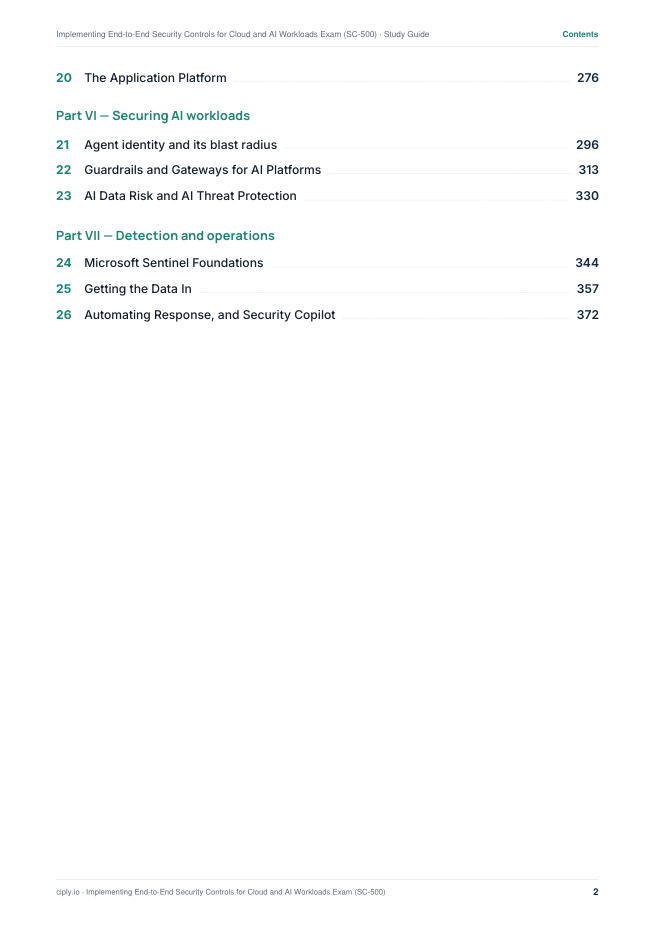
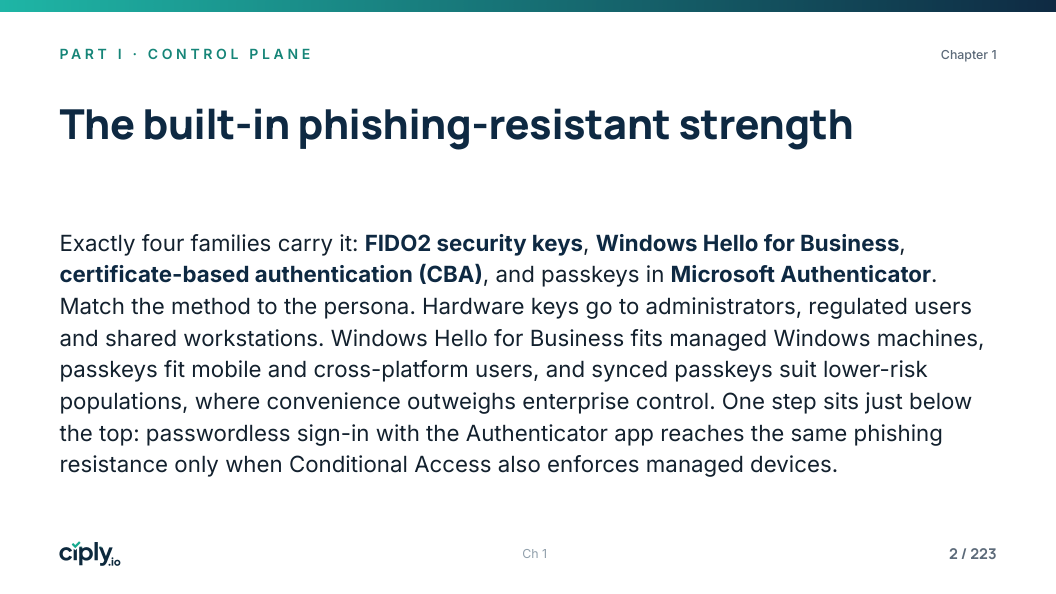
What the designed PDFs look like
Real pages from the files you download — the polish is part of what you're paying for.
Simple pricing, 12 months of access
Practice Exams
- ✓ 812 original questions across all 4 official domains
- ✓ Combined Skills: 30 cross-domain questions — each one turns on two or more official domains at once
- ✓ 4 case studies — one shared scenario, a set of questions, the scenario on screen throughout
- ✓ All four question formats: single, multi-select, drag-and-drop, hotspot
- ✓ Exam, Review and Section modes with a weak-area report
- ✓ Every answer explained and linked to the official Microsoft page behind it
Complete Bundle
- ✓ Everything in Practice Exams — the full bank, Combined Skills and case studies
- ✓ The designed SC-500 Study Guide (PDF), taught in learning order
- ✓ The Quick Recap card deck for last-mile review
- ✓ One purchase, complete preparation
- See what's inside ↓
Study Guide + Quick Recap
- ✓ Designed SC-500 Study Guide (PDF) with original diagrams
- ✓ Quick Recap card deck ending in a cram sheet
- ✓ Plain-English teaching around precise exam terms
- See what's inside ↓
Secure checkout by Stripe · VAT handled · instant access
Introductory launch pricing. The regular price applies after our launch window. Prices shown in USD; local currency and tax shown at checkout.
Who this is for
- Anyone sitting SC-500 for the first time and wanting the blueprint covered, not sampled
- Retakers who need to find the gap that cost them, rather than re-reading everything
- Practitioners stepping up from fundamentals to a role-based certification
- Anyone who wants to check an answer against the official documentation instead of trusting it
Who it isn't for
- Anyone looking for the live exam's actual questions. We don't have them, and nobody should be selling them to you — using them puts your certification at risk and teaches you nothing.
- Anyone who wants to pass without understanding the material. Every answer here comes with the reasoning and the source, which is slower than memorising and the entire point.
Questions people ask before buying
- Are these SC-500 exam dumps?
- No. Every question is original — built on the official exam blueprint and backed by free, public, official Microsoft documentation, with every answer linked to the exact official page behind it. We never use braindumps, leaked questions, or paywalled material. If you are looking for the live exam's actual questions, we do not have them, and we would not sell them.
- How long do I have access?
- 12 months from purchase, including all content updates during that time — certification content changes, so we keep it current rather than promising a hollow 'lifetime'. PDFs you download during that period stay yours to keep.
- Can I try before buying?
- Yes — 16 questions from this bank are free with a free account, in the same player you would use after purchase. Full sample questions with their explanations are also printed on this page.
- What kinds of questions are included?
- The bank has 812 questions across all four formats: single answer, multi-select, drag-and-drop, hotspot. It also includes Combined Skills questions, each of which turns on facts from two or more official domains at once. Case studies are included too: one shared scenario with several questions about it, and the scenario stays on screen while you answer.
- What happens when Microsoft updates the SC-500 exam?
- We re-check the bank against the new Skills Measured outline and update the questions that need it, then republish. Updates during your 12 months are included at no extra cost. We date our claim against Microsoft's published outline rather than simply saying the pack was "recently updated", so you can check the correspondence yourself.
- Can I get a refund?
- Yes, before you access what you bought. Because these are digital products delivered immediately, opening a paid question bank or downloading a purchased PDF ends the statutory 14-day withdrawal right — until you do, it is intact. We also refund genuine cases such as a technical failure we cannot fix. The full detail, including exactly what counts as access, is in our Refund Policy.
Full detail: Refund Policy · Terms · How we build content
The no-dumps promise
Braindump sites recycle stolen exam content — using them risks your certification and teaches you nothing. Every ciply.io question is original: built on the official exam blueprint, backed by official Microsoft documentation, and every answer links the exact page behind it — so you learn why it's right. How we build content →
Every question in this pack maps to Microsoft's published Skills Measured outline for SC-500 — the current outline, last updated 26 April 2026. Microsoft prints no revision date on this particular outline, so that is the date its own page carries. When Microsoft revises it, we re-diff the bank against the new outline. Read Microsoft's outline →
ciply.io is an independent study resource and is not affiliated with, authorized, sponsored, or endorsed by Microsoft. Implementing End-to-End Security Controls for Cloud and AI Workloads Exam, SC-500, and related names are trademarks of their respective owners.