Microsoft · Expert · AZ-305
AZ-305 Practice Exams & Study Guide
461 original practice questions across all four AZ-305 domains, built against the 17 April 2026 objectives — every answer explained and backed by official Microsoft documentation. No dumps, no recycled braindumps: the link to that documentation sits under every answer, so you can check any of it yourself.
Everything in this pack
- 461 original questions, written from official Microsoft documentation
- All four question formats — single answer, multi-select, drag-and-drop, hotspot
- 4 practice modes — Exam, Review, Domain practice, Case Studies
- A weak-area report after every session, scored by official domain
- The designed AZ-305 Study Guide and Quick Recap card deck (PDF, in the bundle)
- Every answer linked to the exact official page behind it
- 16 free to try right now — no card needed
- 12 months of access, including every content update we publish in that time
- Runs in your browser — nothing to install, no player to configure
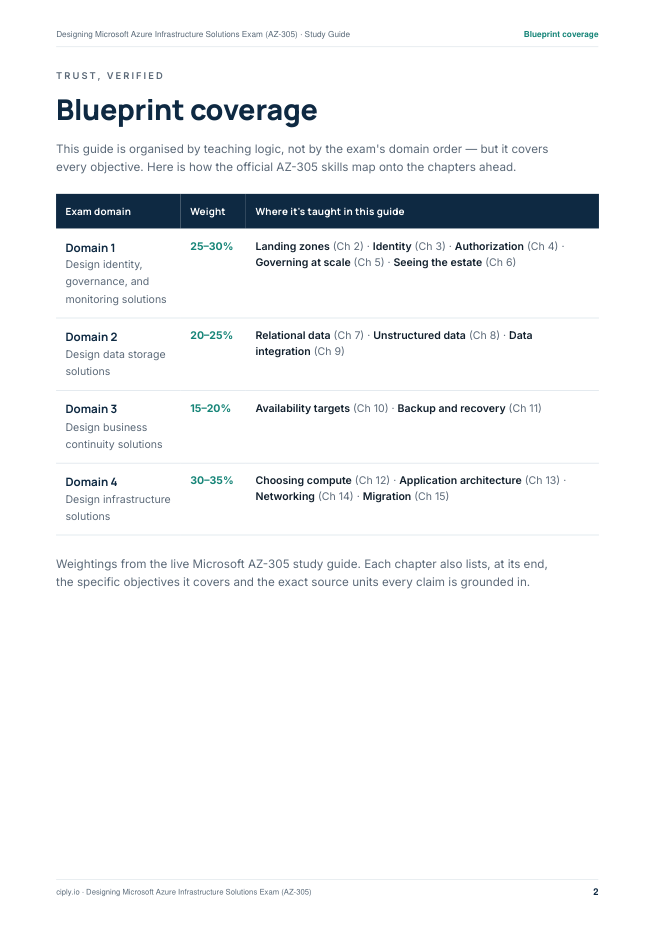
Coverage follows the official AZ-305 blueprint
| Official domain | Exam weight | Our questions |
|---|---|---|
| Design identity, governance, and monitoring solutions | 25–30% | 124 |
| Design data storage solutions | 20–25% | 103 |
| Design business continuity solutions | 15–20% | 81 |
| Design infrastructure solutions | 30–35% | 153 |
Weights from Microsoft's current Skills Measured outline for AZ-305, dated 17 April 2026. Question counts follow the blueprint — never padded to hit a number.
What most AZ-305 practice sets skip
The parts that are hard to write, not just hard to answer
Certification at this level isn't single-fact recall. The objectives describe decisions that cross domains, and scenario work that takes a whole estate into account. We wrote questions for both — grounded in official documentation, like everything else here.
case studies
Read one shared scenario, then answer a set of questions about it. The scenario stays on screen, re-readable, the whole way through — so what's being tested is your judgment, not your memory of a paragraph.
The case studies in this pack
- Case 1Meridian Freight — the datacentre lease that ends in nine months5 q · D1, D2, D3, D4
- Case 2Aldervane Software — one product, two continents5 q · D1, D2, D3, D4
- Case 3Kestrel Health Group — two tenants after an acquisition6 q · D1, D3
- Case 4Northgate Utilities — meter readings, arriving forever5 q · D1, D2, D4
- FreeHalbrook Studios — where the finished artwork lives (free sample)3 q · try it now
What you'll be able to do
- Work through every domain of the AZ-305 blueprint, in the official weighting
- Find your weak domains before the exam does — every session scores you by domain and unit
- Handle all four question formats under time, including drag-and-drop and hotspot
- Explain why an answer is right, not just which one it is — and check it against the official page
Judge the quality yourself
An operations team runs several hundred Windows and Linux virtual machines, plus hybrid servers in two datacentres. They want one definition that states which performance counters and Syslog facilities to gather, applies to every machine, and can be changed centrally without touching each host. What should you recommend?
- a.A separate agent configuration applied per virtual machine so each host can be tuned individually
- b.A Log Analytics workspace per datacentre, relying on workspace membership to decide what is gathered
- c.Data Collection Rules assigned to the machines through data collection rule associations✓ correct
- d.An Azure Policy definition that writes performance thresholds directly onto each machine
An application writes its own diagnostic records to JSON files on each server's local disk. The monitoring design must bring those records into Azure Monitor Logs and query them alongside platform data, without rewriting the application. What should you recommend?
- a.Platform metrics, since the values inside the JSON files are numeric
- b.IIS log collection, because the application is served by a web front end
- c.Windows event collection, after configuring the application to write to the event log
- d.Custom log collection through the Azure Monitor Agent, with the table schema defined in the Data Collection Rule✓ correct
Every explanation names why the right answer is right and what each wrong option actually refers to — that's the standard across all 461 questions. Try 16 of them free →
Look inside the AZ-305 Study Guide
The real opening of Chapter 1 — how the whole guide teaches. The full guide continues like this, chapter by chapter, with original diagrams and verified questions woven in.
Chapter 1 · free excerpt
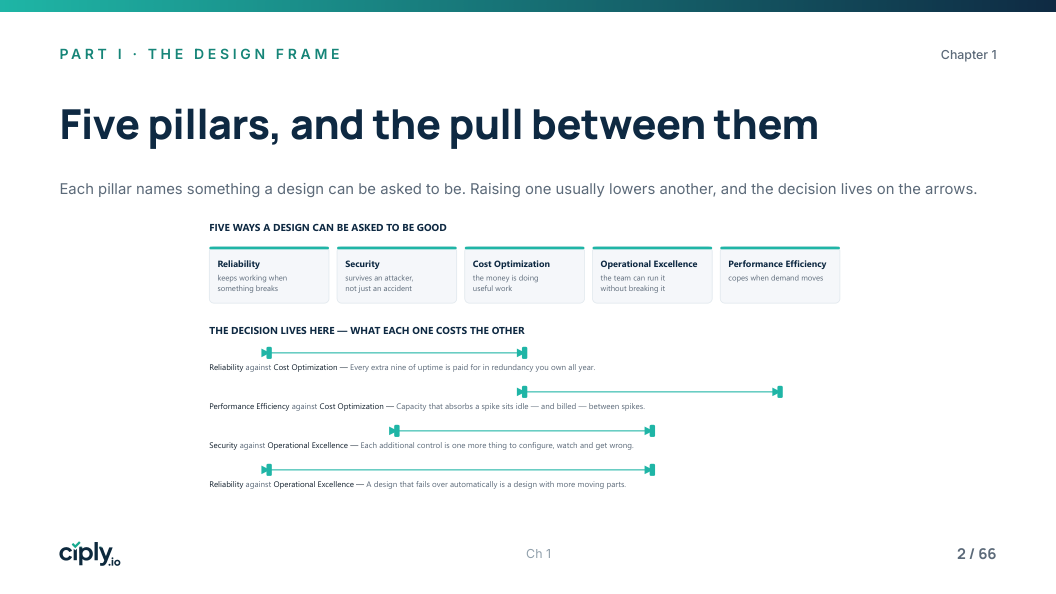
Requirements, constraints, and the trade-off
Every question on this exam asks you to recommend something. Not to define it, not to configure it — to choose it, for a named organisation with named limits. That is a different skill from knowing services, and it is the skill this guide is built to teach. This chapter gives you the words for it.
Mental model
Worked example
Excerpt ends here — the full chapter continues with the five workloads in depth, exam traps, and verified practice questions.
Quick Recap — two of the AZ-305 cards
A landscape card deck for last-mile review, ending in a Cram Sheet. One chapter card and one of the four Cram Sheet cards:
Chapter card
The exam asks you to choose, not to define
Cram sheet · 1 of 4
Dates the exam rewards you for knowing
- 1 May 2025
- Azure AD B2C stopped accepting new customers — existing tenants continue (Ch 3)
- May 2030
- the earliest B2C support runs to (Ch 3)
- 1 April 2026
- Azure Cache for Redis closed to new customers — name Azure Managed Redis (Ch 13)
- 1 October 2028
- Azure Cache for Redis fully retired (Ch 13)
- 31 August 2024
- update management left Azure Automation for Azure Update Manager (Ch 13)
- 2027
- Automation State Configuration retires — Machine Configuration replaces it (Ch 13)
What the designed PDFs look like
Real pages from the files you download — the polish is part of what you're paying for.
Simple pricing, 12 months of access
Practice Exams
- ✓ 461 original questions across all 4 official domains
- ✓ 5 case studies — one shared scenario, a set of questions, the scenario on screen throughout
- ✓ All four question formats: single, multi-select, drag-and-drop, hotspot
- ✓ Exam, Review and Section modes with a weak-area report
- ✓ Every answer explained and linked to the official Microsoft page behind it
Complete Bundle
- ✓ Everything in Practice Exams — the full bank, Combined Skills and case studies
- ✓ The designed AZ-305 Study Guide (PDF), taught in learning order
- ✓ The Quick Recap card deck for last-mile review
- ✓ One purchase, complete preparation
- See what's inside ↓
Study Guide + Quick Recap
- ✓ Designed AZ-305 Study Guide (PDF) with original diagrams
- ✓ Quick Recap card deck ending in a cram sheet
- ✓ Plain-English teaching around precise exam terms
- See what's inside ↓
Secure checkout by Stripe · VAT handled · instant access
Introductory launch pricing. The regular price applies after our launch window. Prices shown in USD; local currency and tax shown at checkout.
Who this is for
- Anyone sitting AZ-305 for the first time and wanting the blueprint covered, not sampled
- Retakers who need to find the gap that cost them, rather than re-reading everything
- Architects who already hold an associate certification and are moving up to expert-level design decisions
- Anyone who wants to check an answer against the official documentation instead of trusting it
Who it isn't for
- Anyone looking for the live exam's actual questions. We don't have them, and nobody should be selling them to you — using them puts your certification at risk and teaches you nothing.
- Anyone who wants to pass without understanding the material. Every answer here comes with the reasoning and the source, which is slower than memorising and the entire point.
Questions people ask before buying
- Are these AZ-305 exam dumps?
- No. Every question is original — built on the official exam blueprint and backed by free, public, official Microsoft documentation, with every answer linked to the exact official page behind it. We never use braindumps, leaked questions, or paywalled material. If you are looking for the live exam's actual questions, we do not have them, and we would not sell them.
- How long do I have access?
- 12 months from purchase, including all content updates during that time — certification content changes, so we keep it current rather than promising a hollow 'lifetime'. PDFs you download during that period stay yours to keep.
- Can I try before buying?
- Yes — 16 questions from this bank are free with a free account, in the same player you would use after purchase. Full sample questions with their explanations are also printed on this page.
- What kinds of questions are included?
- The bank has 461 questions across all four formats: single answer, multi-select, drag-and-drop, hotspot. Case studies are included too: one shared scenario with several questions about it, and the scenario stays on screen while you answer.
- What happens when Microsoft updates the AZ-305 exam?
- We re-check the bank against the new Skills Measured outline and update the questions that need it, then republish. Updates during your 12 months are included at no extra cost. We date our claim against Microsoft's published outline rather than simply saying the pack was "recently updated", so you can check the correspondence yourself.
- Can I get a refund?
- Yes, before you access what you bought. Because these are digital products delivered immediately, opening a paid question bank or downloading a purchased PDF ends the statutory 14-day withdrawal right — until you do, it is intact. We also refund genuine cases such as a technical failure we cannot fix. The full detail, including exactly what counts as access, is in our Refund Policy.
Full detail: Refund Policy · Terms · How we build content
The no-dumps promise
Braindump sites recycle stolen exam content — using them risks your certification and teaches you nothing. Every ciply.io question is original: built on the official exam blueprint, backed by official Microsoft documentation, and every answer links the exact page behind it — so you learn why it's right. How we build content →
Every question in this pack maps to Microsoft's published Skills Measured outline for AZ-305 — the current outline, dated 17 April 2026. When Microsoft revises it, we re-diff the bank against the new outline. Read Microsoft's outline →
ciply.io is an independent study resource and is not affiliated with, authorized, sponsored, or endorsed by Microsoft. Designing Microsoft Azure Infrastructure Solutions Exam, AZ-305, and related names are trademarks of their respective owners.